A dose-response audit specifies a tone-neutral, capture-robust measure of skin radiance
Graders can rank two faces reliably and cannot say what they are ranking on. That is a measurement problem before it is a modeling problem, a question of construct validity16. Skin radiance has been quantified before, with optical reflectance devices1, digital image models calibrated to expert and consumer grading2, and fractal analysis of luminance and color evenness4. Using polarized imaging15, Matsubara and colleagues showed that graded radiance depends on both a surface-reflection (gloss) component and a subsurface, lightness-like one3, consistent with evidence that perceived gloss and lightness share luminance-histogram cues12. Those studies worked on controlled rigs; there is still no shared definition that transfers to ordinary photographs, where tone estimates such as ITA7,8 are known to track capture conditions as well as skin9,10. We found no earlier radiance or gloss metric audited by dose-response perturbation and capture sensitivity, nor a measurement of how tone-dependent a fixed-threshold specular detector is, though the search was by keyword. We therefore built a transparent radiance metric from physiological image features, tested whether it responds to what it claims to measure, and audited how far the camera moves it (Methods). The metric was developed independently on public data; a consulting client later applied the method to its own data and validated it against the client's expert grading. Those figures belong to the client's data and are not reproducible from anything public, so the repository does not cite them — it carries the validation reported here instead.
The original score cannot tell gloss from brightness
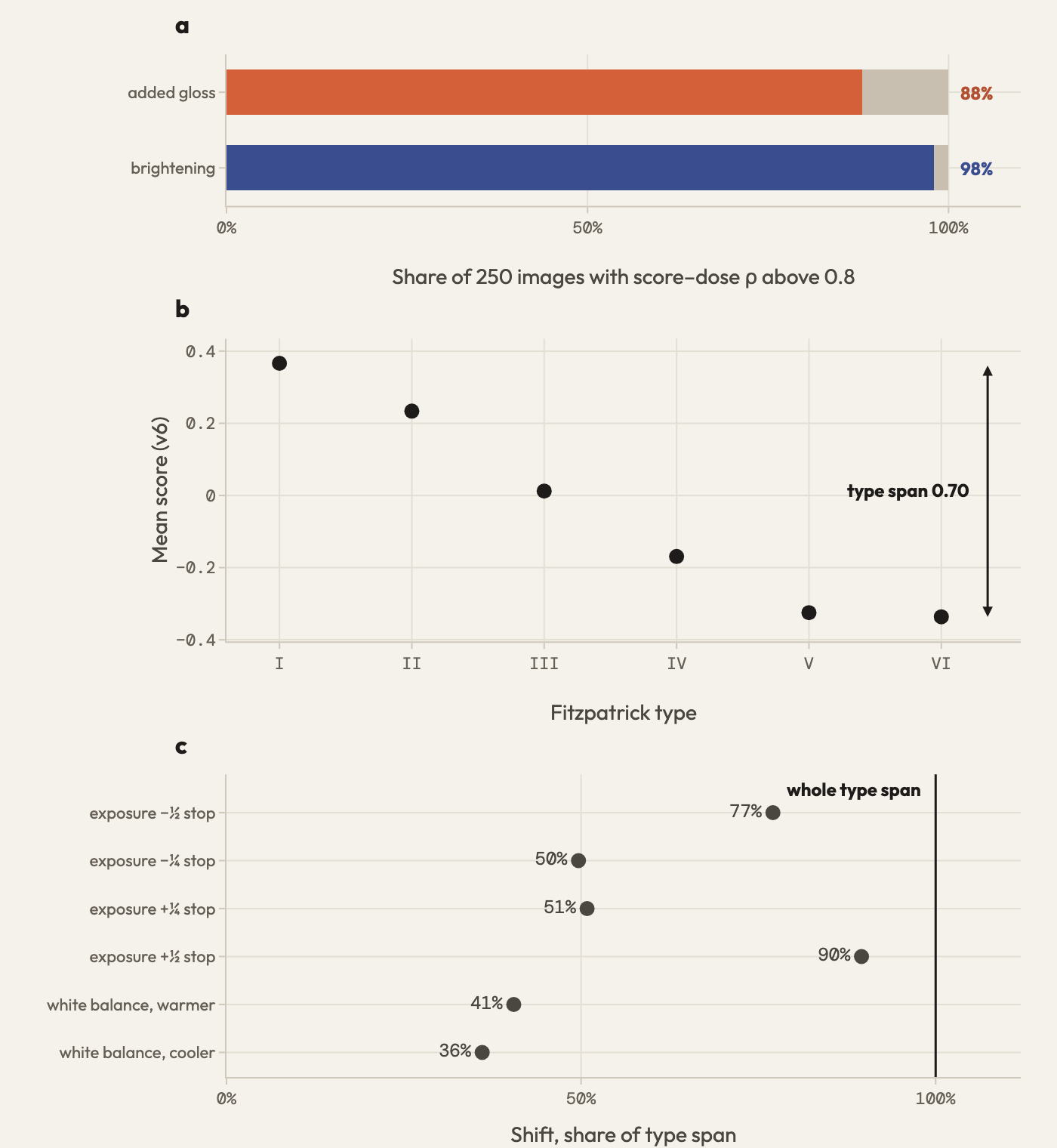
On 1,816 Fitzpatrick17k images5 stratified across all six skin types6, the score tracked added gloss at median Spearman ρ = 1.00 — and tracked plain brightening at ρ = 1.00 as well (Fig. 1a). It does not separate gloss from lightness. That follows from its own definition, in which mean L* carries a +0.25 weight. The weight is not arbitrary: perceived radiance depends on both a surface (gloss) and a subsurface, lightness-like component3, and perceived gloss and lightness share the same luminance cues12. Whether lightness belongs in the construct is a choice, and the variants below make it explicitly. Skin tone explains roughly 28.5% of the score's variance, and mean glow declines monotonically from Fitzpatrick type 1 to type 6 (Fig. 1b).
The camera moves the score as far as several steps of skin type
That tone gradient's size is not established — and why not is the more interesting result. Fitzpatrick17k is scraped clinical photography: no controlled illumination, no camera calibration, no color reference in frame, and tone estimates from such images are known to track capture as well as skin9,10. Re-scoring each image under capture changes that cannot alter how glossy skin actually is showed a quarter-stop exposure difference moving the score by ~51% of the entire type-1-to-type-6 span, half a stop by 90%, and a 10% white-balance drift by ~40% (Fig. 1c). The metric is about as sensitive to the camera as to several steps of skin type, so nothing in this dataset separates the two. The within-image findings are untouched, because there each image is its own control and illumination is fixed by construction.
The obvious repair fails, and its failure is a specification
Dropping the lightness term and keeping the specular one does not give a tone-neutral metric, because the specular detector counts pixels over an absolute brightness threshold and is itself 5.3× higher on the lightest skin than the darkest. A tone-independent radiance metric needs highlight contrast measured against each image's own baseline rather than a fixed cut — a concrete specification for the next version, arrived at by measurement rather than by argument. The audit thus gave an acceptance criterion rather than a complaint: keep the response to gloss, lose the response to brightness, bring capture sensitivity down.
Seven variants, scored through identical experiments, end tone-neutral
Seven variants were scored through identical experiments, so every change was attributable rather than bundled. Tone dependence ends at ρ² = 0.002, down from 0.310, and worst-case capture sensitivity at 59.4%, down from 93.2% — while the response to real gloss improves (Fig. 2).
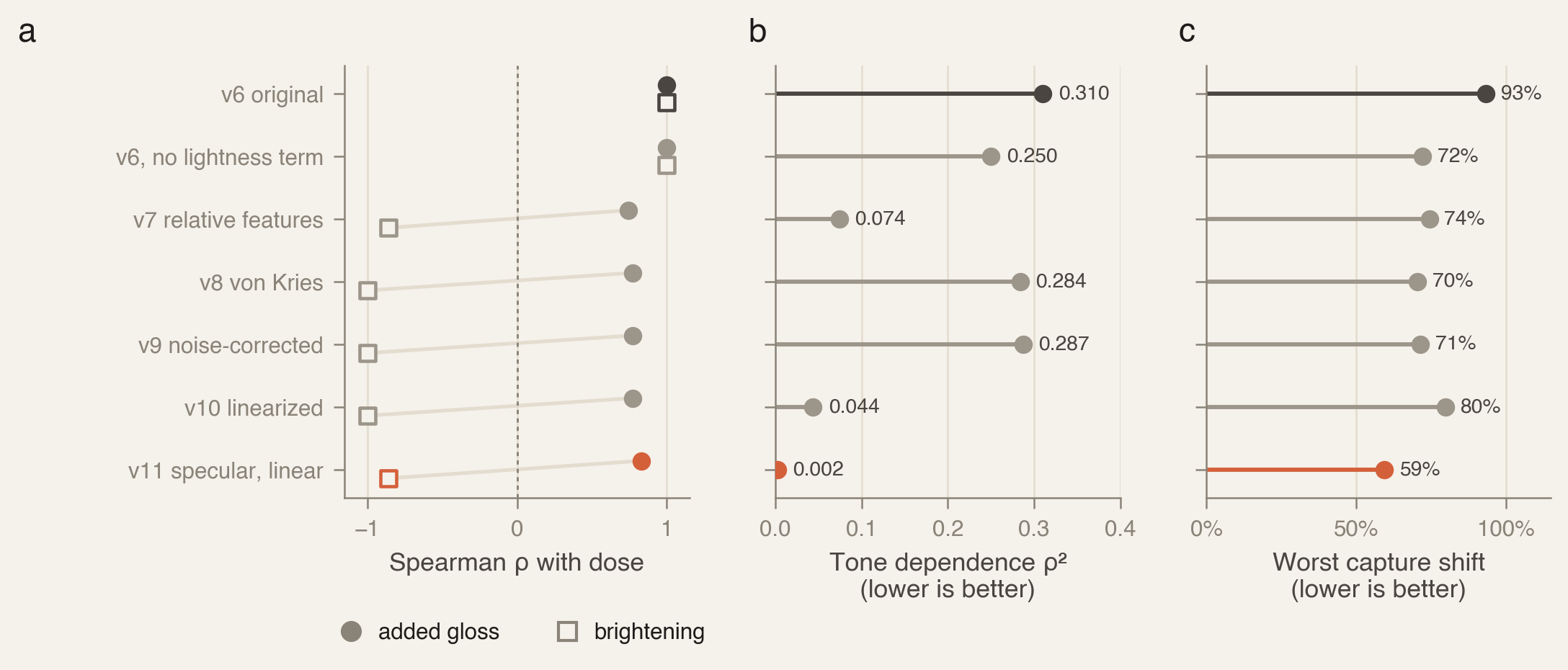
Three of those variants are failures, and they are kept because the sequence is the argument. Deleting the lightness term did nothing, because the remaining terms are absolute too (Fig. 2a). Re-expressing everything as ratios fixed exposure and broke white balance, since the specular test gates on saturation and warming an image raises saturation — repaired by von Kries normalization13, a standard color-constancy step in dermatology imaging14, because an illuminant change is to first order a diagonal transform R→aR, G→bG, B→cB, so dividing each channel by a statistic of itself cancels it.
The most useful failure was the next one. The residual tone dependence was hypothesized to be that same normalization amplifying sensor noise on darker skin, which carries least signal above the floor. That correction was implemented in full — per-image noise estimation, spread terms reduced in quadrature — and changed nothing, because the measured noise floor is about 2% of the skin median against relative spreads of 20–37%.
Ruling it out identified the real cause, and it was color science rather than statistics. Von Kries is a linear model, and sRGB pixel values are not radiance: under a ~1/2.2 transfer curve, a fixed linear ratio maps to different encoded ratios depending on level — which on skin means depending on skin tone. Undoing the curve first took the specular term's own tone correlation from +0.47 to −0.08. Weighting the metric onto that now-neutral term is the final variant (Fig. 2b, c), and it requires excluding clipped pixels from the measurement region: a saturated pixel is maximally bright and minimally saturated, which is precisely the specular signature, so without the exclusion raising exposure manufactures gloss that was never in the scene.
Discussion
A transparent radiance score built on public photographs could not separate gloss from brightness, and the camera moved it about as far as several steps of skin type; a sequence of seven variants, each scored through the same dose-response and capture experiments, ended with a tone-neutral, less capture-sensitive metric whose repairs rest on the dichromatic reflection model11, von Kries adaptation13 and color-constancy practice in dermatology imaging14. None of this makes the original measurement useless. It establishes that what that metric captures is surface reflectance including lightness, under whatever illumination the photograph was taken in — a defensible thing to call radiance on a fixed capture rig, which is how earlier radiance studies worked1,3,15, which is what the original engagement had and what public dermatology data does not. Exposure and white-balance sensitivity are now the acceptance criterion for any revised metric.
What remains unfixed is stated alongside it. Every variant still responds to a tone curve, because gamma is not a diagonal transform and no per-channel gain cancels one. Residual exposure sensitivity is bounded by clipping already present in the source. And tone neutrality is established on a single source atlas. Public dermatology datasets label skin type, not radiance, so nothing here is a comparison against ground-truth glow; the client engagement's validation against expert grading is described but not claimed here.
Methods
Feature extraction. Features were extracted per region — full face, center, forehead, both cheeks, chin — with optional face detection anchoring the regions, then aggregated to subject level. The feature space is deliberately interpretable rather than learned: CIE Lab and ITA7,8 for tone, hue statistics, texture descriptors, and explicit specular, red, and dark proxies; the specular proxy follows the dichromatic reflection model, in which highlights carry the illuminant's color11.
Composite scores. Composite scores are computed at image, subject-region, and subject level, and the composition is transparent by design — a score you cannot decompose is a score nobody will trust or act on. Supervised modeling is optional and only engages when grading labels are present.
Ingestion. Ingestion works from either a folder hierarchy or a manifest CSV, so the pipeline is dataset-agnostic.
Version history. The methodology went through six versions before this audit, and that history is part of the substance: each iteration tightened what counted as signal versus artifact — specular highlights that read as glow but are really lighting, tone shifts that are really white balance, texture that is really compression. The audited score is v6; the seven variants scored here follow it.
Dose-response validation. Public dermatology datasets label skin type, not radiance, so there is nothing to correlate a glow score against; the validation instead perturbs with a known dose — a controlled specular highlight, a global gamma brightening, or fine noise — and measures how the score tracks the dose, with Spearman correlation computed per image across doses. Gamma is the control that carries the argument, because it raises lightness while adding no gloss whatsoever. The sample is 1,816 Fitzpatrick17k images5 stratified across all six skin types6, with the dose-response panels drawn on 250 images at six doses each.
Capture audit. Each image was re-rendered under capture changes that cannot alter how glossy skin actually is — exposure shifts of a quarter and half stop in each direction and 10% white-balance drifts warmer and cooler — and the mean absolute score change was expressed as a share of the type-1-to-type-6 span (for the original score) or of the score's spread across images (for variant comparison, a denominator that stays comparable when a variant removes the tone gradient).
Variant scoring. All seven variants ran through identical experiments, so every change is attributable rather than bundled; failed variants were kept and reported, including a noise-floor correction implemented in full — per-image noise estimation, spread terms reduced in quadrature — that changed nothing.
Reporting. The validation report is generated into the repository from the run's own output, so the documented numbers cannot drift from the run that produced them.
Data availability
The validation runs on Fitzpatrick17k5, a public dataset of clinical photographs with skin-type labels6 and no radiance labels. No client data is used or reproduced anywhere in the open validation.
Code availability
The analysis repository is private. It reproduces the method, carries the reproducible validation reported here and the illumination-invariant metric that validation specified, and its documentation is generated from the run's own output. The client engagement's figures are described but not claimed, here or in the repository.
Protocol
This work was not pre-registered. The v6 audit fixed the acceptance criterion — keep the response to gloss, lose the response to brightness, bring capture sensitivity down — before the variant sequence was scored, and all seven variants then ran through identical experiments; dead ends were implemented in full and are reported as such rather than removed.
Competing interests
None.
References
- Petitjean A, Sainthillier JM, Mac-Mary S, et al. Skin radiance: how to quantify? Validation of an optical method. Skin Research and Technology 13, 2–8 (2007). doi:10.1111/j.1600-0846.2006.00174.x.
- Baret M, Bensimon N, Coronel S, et al. Characterization and quantification of the skin radiance through new digital image analysis. Skin Research and Technology 12, 254–260 (2006). doi:10.1111/j.0909-752X.2006.00158.x.
- Matsubara A, Liang Z, Sato Y, Uchikawa K. Analysis of human perception of facial skin radiance by means of image histogram parameters of surface and subsurface reflections from the skin. Skin Research and Technology 18, 265–271 (2012). doi:10.1111/j.1600-0846.2011.00570.x.
- Haeri M, Phamduy T, Cafone N, et al. Novel digital image analysis using fractal dimension for assessment of skin radiance. Skin Research and Technology 25, 564–571 (2019). doi:10.1111/srt.12687.
- Groh M, Harris C, Soenksen L, et al. Evaluating deep neural networks trained on clinical images in dermatology with the Fitzpatrick 17k dataset. Proceedings of the IEEE/CVF CVPR Workshops, 1820–1828 (2021). doi:10.1109/CVPRW53098.2021.00201.
- Fitzpatrick TB. The validity and practicality of sun-reactive skin types I through VI. Archives of Dermatology 124, 869–871 (1988). doi:10.1001/archderm.1988.01670060015008.
- Chardon A, Cretois I, Hourseau C. Skin colour typology and suntanning pathways. International Journal of Cosmetic Science 13, 191–208 (1991). doi:10.1111/j.1467-2494.1991.tb00561.x.
- Del Bino S, Bernerd F. Variations in skin colour and the biological consequences of ultraviolet radiation exposure. British Journal of Dermatology 169, 33–40 (2013). doi:10.1111/bjd.12529.
- Groh M, Harris C, Daneshjou R, et al. Towards transparency in dermatology image datasets with skin tone annotations by experts, crowds, and an algorithm. Proceedings of the ACM on Human-Computer Interaction 6, 1–26 (2022). doi:10.1145/3555634.
- Kinyanjui NM, Odonga T, Cintas C, et al. Fairness of classifiers across skin tones in dermatology. MICCAI 2020, Lecture Notes in Computer Science, 320–329 (2020). doi:10.1007/978-3-030-59725-2_31.
- Shafer SA. Using color to separate reflection components. Color Research & Application 10, 210–218 (1985). doi:10.1002/col.5080100409.
- Motoyoshi I, Nishida S, Sharan L, Adelson EH. Image statistics and the perception of surface qualities. Nature 447, 206–209 (2007). doi:10.1038/nature05724.
- West G, Brill MH. Necessary and sufficient conditions for von Kries chromatic adaptation to give color constancy. Journal of Mathematical Biology 15, 249–258 (1982). doi:10.1007/BF00275077.
- Barata C, Celebi ME, Marques JS. Improving dermoscopy image classification using color constancy. IEEE Journal of Biomedical and Health Informatics 19, 1146–1152 (2015). doi:10.1109/JBHI.2014.2336473.
- Anderson RR. Polarized light examination and photography of the skin. Archives of Dermatology 127, 1000–1005 (1991). doi:10.1001/archderm.1991.01680060074007.
- Cronbach LJ, Meehl PE. Construct validity in psychological tests. Psychological Bulletin 52, 281–302 (1955). doi:10.1037/h0040957.