Selected work.
Frameworks for testing whether a result holds up, the research that uses them, and the systems built along the way. Each entry gives its status; research links to a write-up, and supporting work is shown as screenshots.
Frameworks
The frameworks the research builds on, each proven in real use and measured against a plain baseline, with fixes found in use going back into the framework.
recolo.
Memory for LLM agents, tested against plain retrieval under protocols committed before scoring. The current design is a summary-first store: a model labels each session as adding, updating or retracting a remembered item, and a retraction removes the item along with its source sessions. On Memora, at the same 1,000-token read budget, it scored 0.278 against 0.182 for plain retrieval and 0.177 for rolling compaction, the production approach (both differences +0.10, 95% intervals above zero); absolute scores stay low. It replaced the original bio-inspired design (decay, salience and consolidation), which lost to plain retrieval on LongMemEval (0.32 against 0.73) and which four follow-up protocols could not rescue. Reported as-is.
Perceptual & Imaging Phenotyping
Measurement science for visible traits that have no ground truth, each tested against a fixed baseline rather than on its own terms.
iridis.
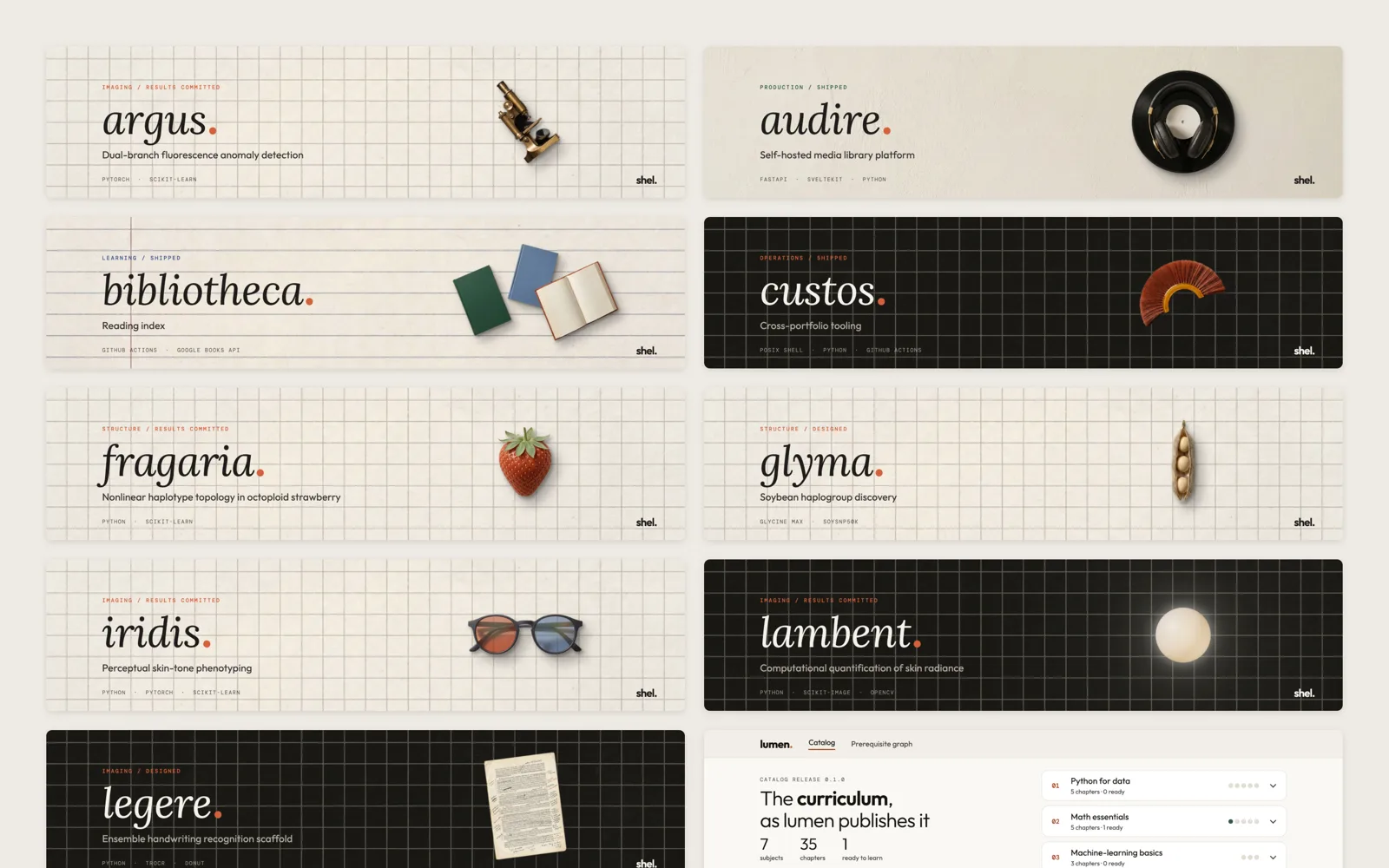
Perceptual skin-tone phenotyping over ~17.8K open dermatology images (Fitzpatrick17k, ISIC 2018). A layered masking pipeline — foreground segmentation plus a ResNet18-U-Net lesion mask (held-out Dice 0.889) — isolates skin before CIE Lab featurization and CIEDE2000 perceptual clustering. Measured color barely tracks Fitzpatrick type: type explains 7% of lightness variance, and predicting it from color barely beats guessing the commonest type (35–42% against 34%); masking did not help. An earlier claim that discovered clusters were 2.5–2.8× more predictable was withdrawn as largely circular; a pre-registered retest found no stable color categories at all (resampling ARI 0.31). Against a colorimeter on a second dataset, an independent reanalysis reproduced the dataset authors' finding that Fitzpatrick type tracks skin color and Monk Skin Tone tracks it better, while image-derived color does not, and measured how much of the image error is capture alone: the weak link was the camera, not the scale.
- lambent.
- argus.
oncos.
Work in progress: 3D deep learning for overall-survival prediction in non-small cell lung cancer from pre-treatment CT, on public imaging data, evaluated against classical survival baselines under a protocol fixed before any model was scored.
legere.
Architecture for on-premises handwriting extraction from mixed-content forms: template-based field segmentation, a benchmarking matrix that tests every model against every field type before routing, vision-language arbitration across predictions, and a human review queue with per-field provenance. The repository is the scaffold for that design; model adapters are interface stubs.
Certified Structure in Biological Data
Deciding when latent structure in high-dimensional biological data is real enough to act on, by running crop genomes through topos's gates to a GO, KILL or HOLD.
fragaria.
Nonlinear haplotype topology in octoploid strawberry: does manifold learning recover stable population structure beyond PCA? An audit found the first Stage 0 invalid; two pre-registered rebuilds followed. The second — 234 unrelated accessions by KING kinship, missingness tested within germplasm source — returns GO in every sensitivity run. PCA and UMAP find the same two groups wherever both cluster, so stable structure exists and nothing yet shows structure beyond PCA. Pre-registered tests on two wild whole-genome panels (woodland strawberry; wild octoploids, under a stricter rule) found the same: stable structure that is geographic or taxonomic, and linear, so the nonlinear hypothesis found no support, though the test has no positive control yet; a rerun with UMAP on genotypes rather than principal components agreed. A crossing-value stage then ranked wild groups by the variation they would add to breeding programs: F. chiloensis first, carrying common alleles the programs lack at 12% of sites. An association scan confirmed a fruit-size locus the source study had already reported, placed it on subgenome 1B with a targeted second pass, and checked the placement against an independent marker table; its larger-fruit allele is common in wild octoploids. A replication at UC Davis found no effect but had about 50% power, and whether the array marker still tags the haplotype there is unresolved, so the locus remains untested outside Florida. Paused.
glyma.
A topos case study testing whether nonlinear manifold learning reveals stable soybean haplogroup substructure beyond PCA on SoySNP50K, with conditional escalation into phenotype, transcriptomic and geo-climatic validation. Protocols complete; analysis not yet run.
sorghum.
Reproducible detection of transposable element insertion-site polymorphisms in Sorghum bicolor: can insertion sites be called reproducibly under perturbation of coverage, filtering and annotation scope before any interpretation is attempted? Go/kill criteria gate escalation; the pilot has not yet run.
- lyco.
- repbox.
Supporting evidence
The systems built along the way, shown as they run. Screens use demo data.
 01
01menhir.
Athlete and coach training platform; generated programs are validated before they commit.
 02
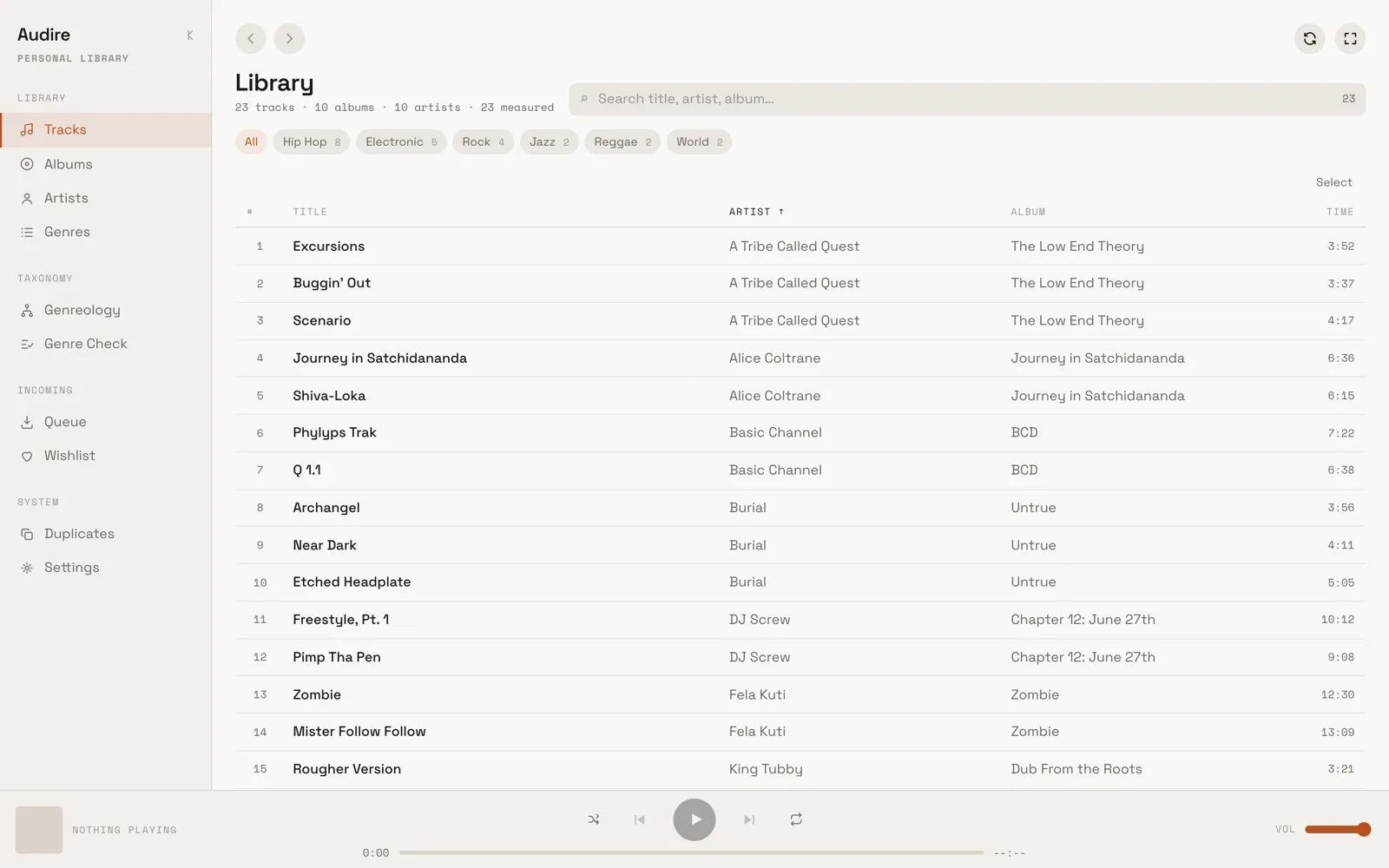
02Cella.
Cella's music section, Audire: a self-hosted audio library packaged as a Home Assistant add-on.
 03
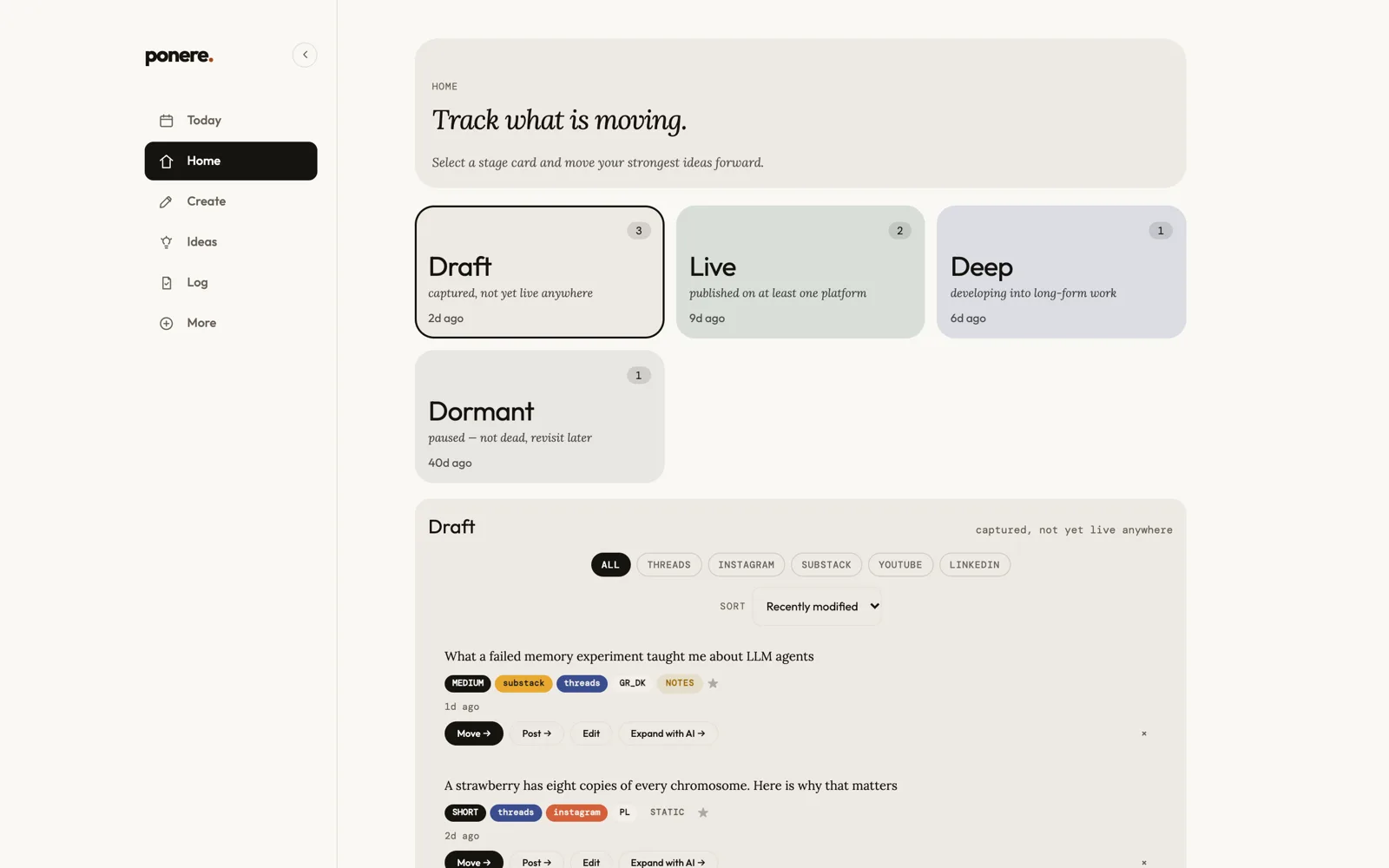
03ponere.
Takes an idea from capture to published post, and flags what has gone quiet.
 04
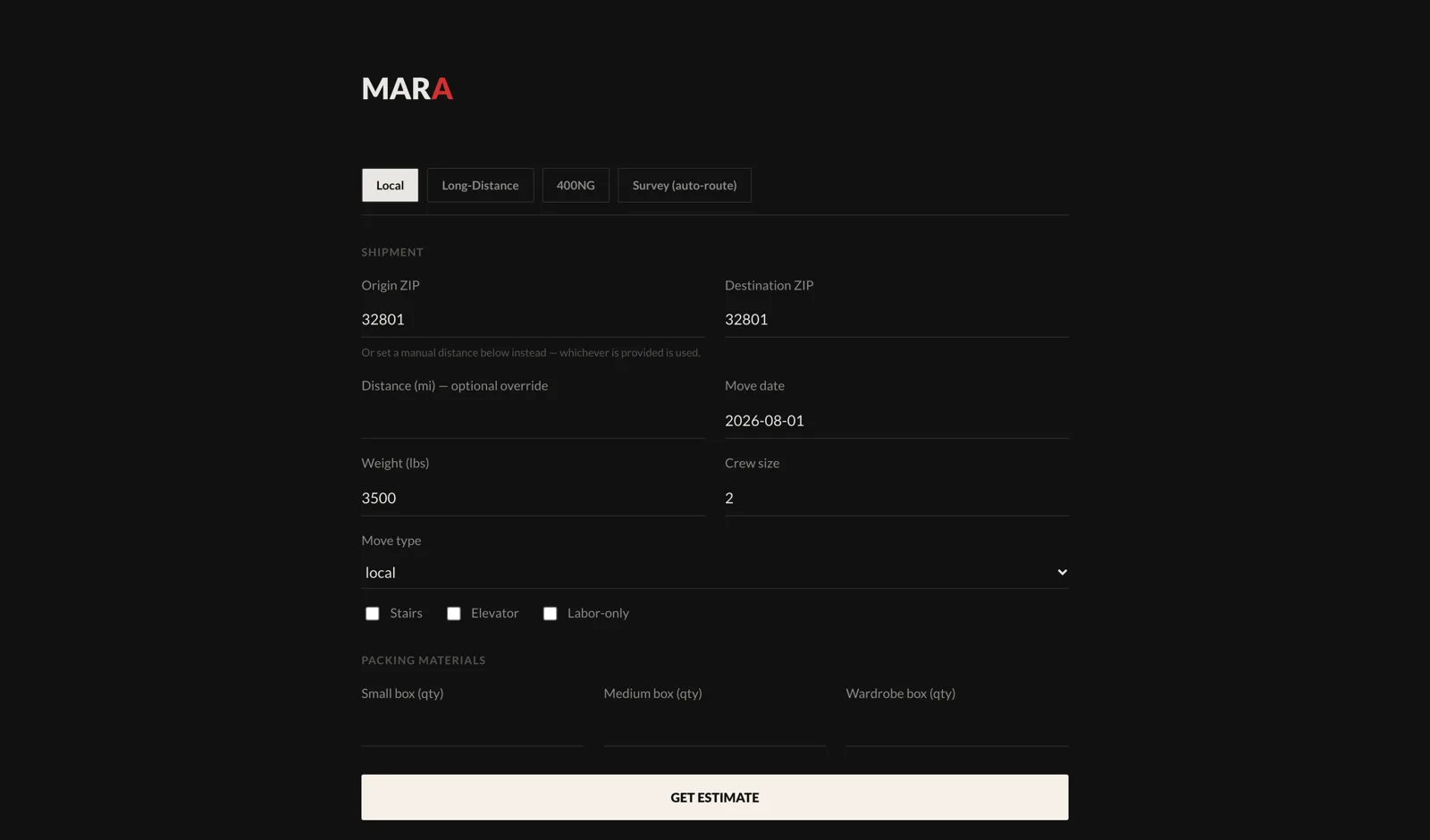
04mara.
Moving-industry pricing API; this quote form calls it live.
 05
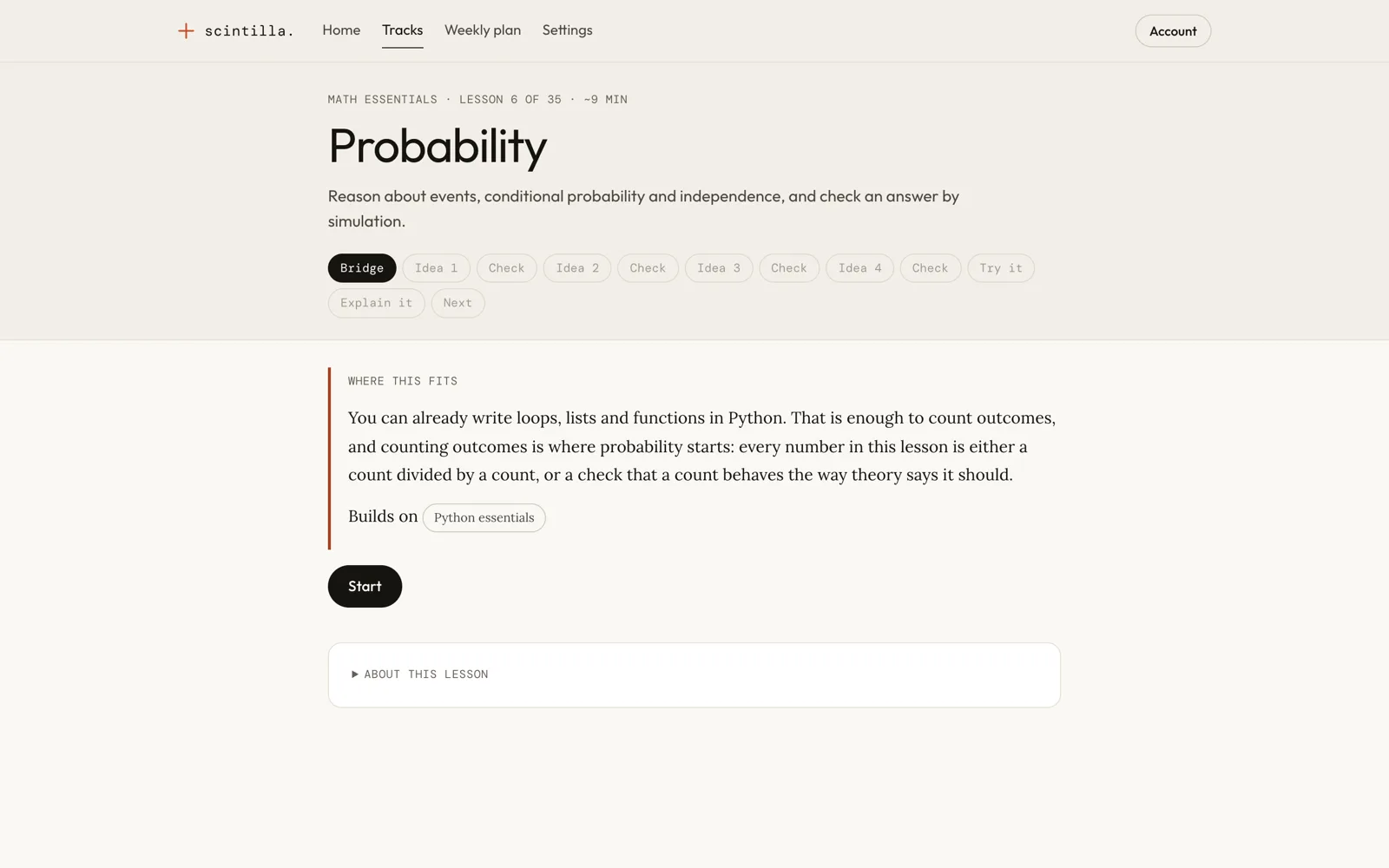
05scintilla.
Lesson player that checks understanding throughout every lesson.
 06
06lumen.
Authoring pipeline that verifies every claim before a lesson is published.

Public reading index driven entirely by filenames.
 08
08custos.
Cross-portfolio tooling: rotation and drift reports, and every repo's README banner.